On AI-Driven Creative Work
This is a fascinating topic. I mainly want to share some of my current thoughts on using AI to generate game narratives and art assets.
Some Controversy Surrounding Cat Fantasy
Over the past couple of days, I was browsing Kaituo Xin. As it happens, this game was invested in by my former employer, and I came across some drama involving a former writer and the game. I will not go into the story of the development team or the former writer here. Instead, I want to talk about the mental state of creators. When creating something, a creator naturally puts themselves in the role of the project’s protagonist. I believe that without identifying with that role, whatever they make will have no soul.
However, once a creator is separated from the project, they may begin to appear somewhat hysterical. Some observers will understand, while others will think they are putting on an act or making a mountain out of a molehill. I knew people like this at my former company. After the project chose to leave one of them behind, he remained convinced that the company had treated him ruthlessly and let down a great many people. Setting aside who was right or wrong for now, I do think that this kind of mental state makes it difficult to continue developing future projects. Perhaps people like this can only make projects of their own and find it difficult to work for others.
VA-11 Hall-A
I also discussed creative work with a friend who is a 2D artist, and his view differs somewhat from mine. I believe that creators can only make good work when their material circumstances provide an environment that keeps them physically and mentally healthy. He believes that as long as their inner world remains healthy, they can still create a good game. VA-11 Hall-A is a perfect example: even though its creators lived in a country affected by conflict, they still made a story-driven game that became popular around the world.
Looking back, history offers plenty of similar examples, such as Du Fu in the Tang dynasty and Lu Xun during the Republican era. Their living conditions were far from comfortable, and they even faced turmoil both at home and abroad, yet they still created outstanding works. So the points raised by my artist friend are not without merit.
To create something truly good, the external environment may play a small part, but the real key is to strengthen your inner self and maintain a healthy psychological and mental state.
My Experiments with AI-Driven Creation Over the Past Two Days
Over the past two days, I have spent a huge number of tokens—more than 50% of my weekly Codex Pro plan—experimenting with AI-generated narratives and images. Two things are clear. First, AI can already collect a wide range of materials, build up the necessary knowledge systematically and comprehensively, and check logic. On the other hand, AI-generated material, including both images and text, still contains many problems—problems that a human would almost never produce, but that AI sometimes does.
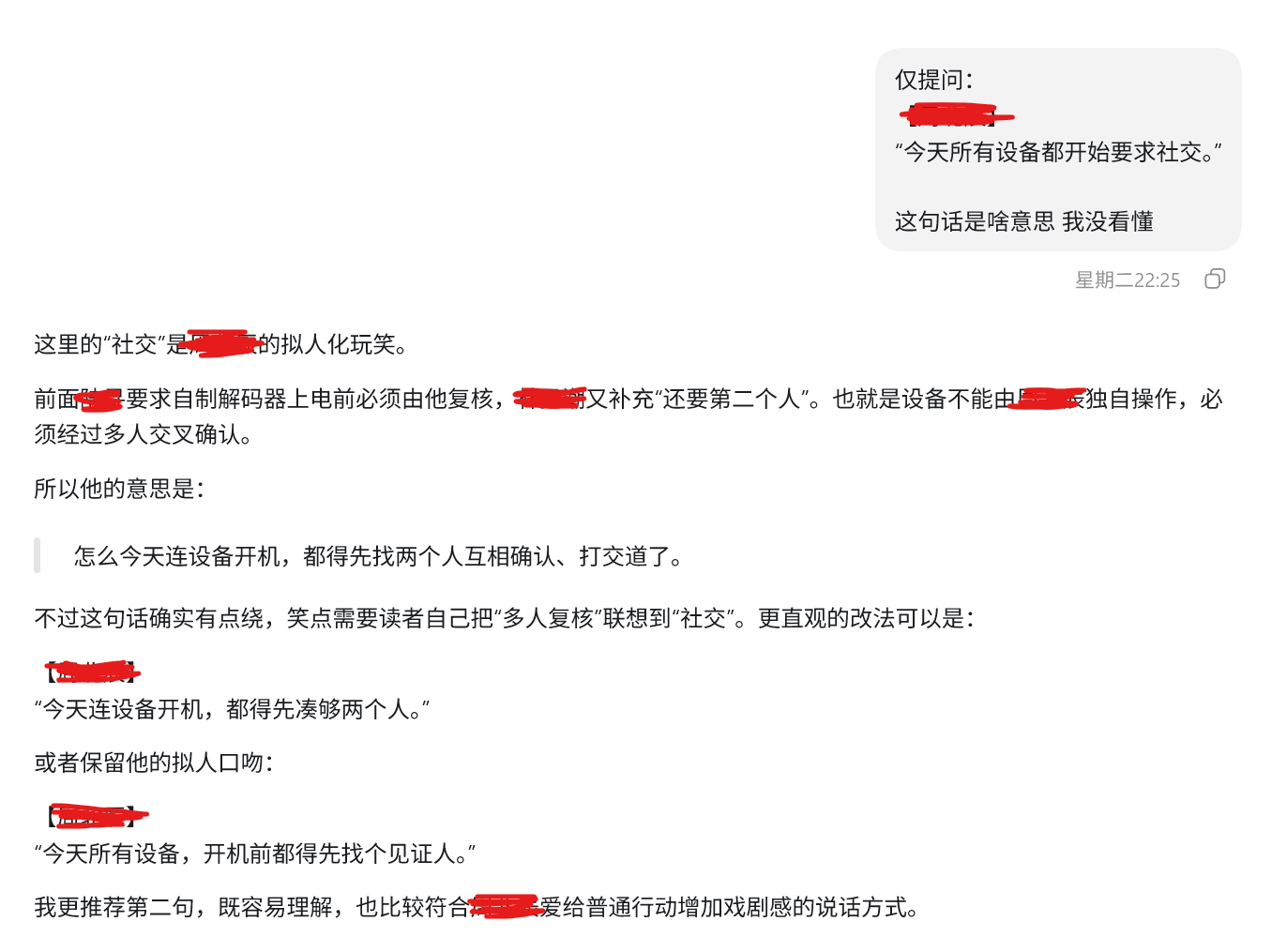
Take the text above as an example. The AI thought it had written something witty and humorous, but to a human reader, the sentence simply does not flow at all. From an engineering perspective, I think the AI may have blended grammar and knowledge of idioms from different languages and language families. Once that knowledge is mixed together and expressed within the Chinese language system, however, the result is confusing. AI-generated text therefore cannot yet be used entirely as-is.
A Few Conclusions
There is nothing wrong with using AI to quickly generate placeholder images and scripts. But if you want to create something genuinely good, AI-generated elements need to be removed as much as possible. This is not to say that AI produces bad work, but that it still cannot meet our creative needs. At present, AI simply cannot create content imbued with personal emotion.